What Is an AI Receptionist? Everything Service Businesses Need to Know

Tadeáš Manas
Founder, SimplifAI Solutions

You run a service business. Your phone rings while you're on a job site, in a crawlspace, or halfway through an appointment with someone else. You can't answer. That caller waits three seconds, hangs up, and dials the next business on Google.
That's a job you'll never know you lost.
An AI receptionist for small business fixes exactly that problem. I've built custom AI receptionists for service businesses across the country, and the pattern never changes: businesses that answer every call win more jobs. Full stop.
In this guide, I'll cover what an AI receptionist is, what it actually does, who benefits most, and the mistakes to avoid when setting one up. No jargon.
Quick answer: What is an AI receptionist?
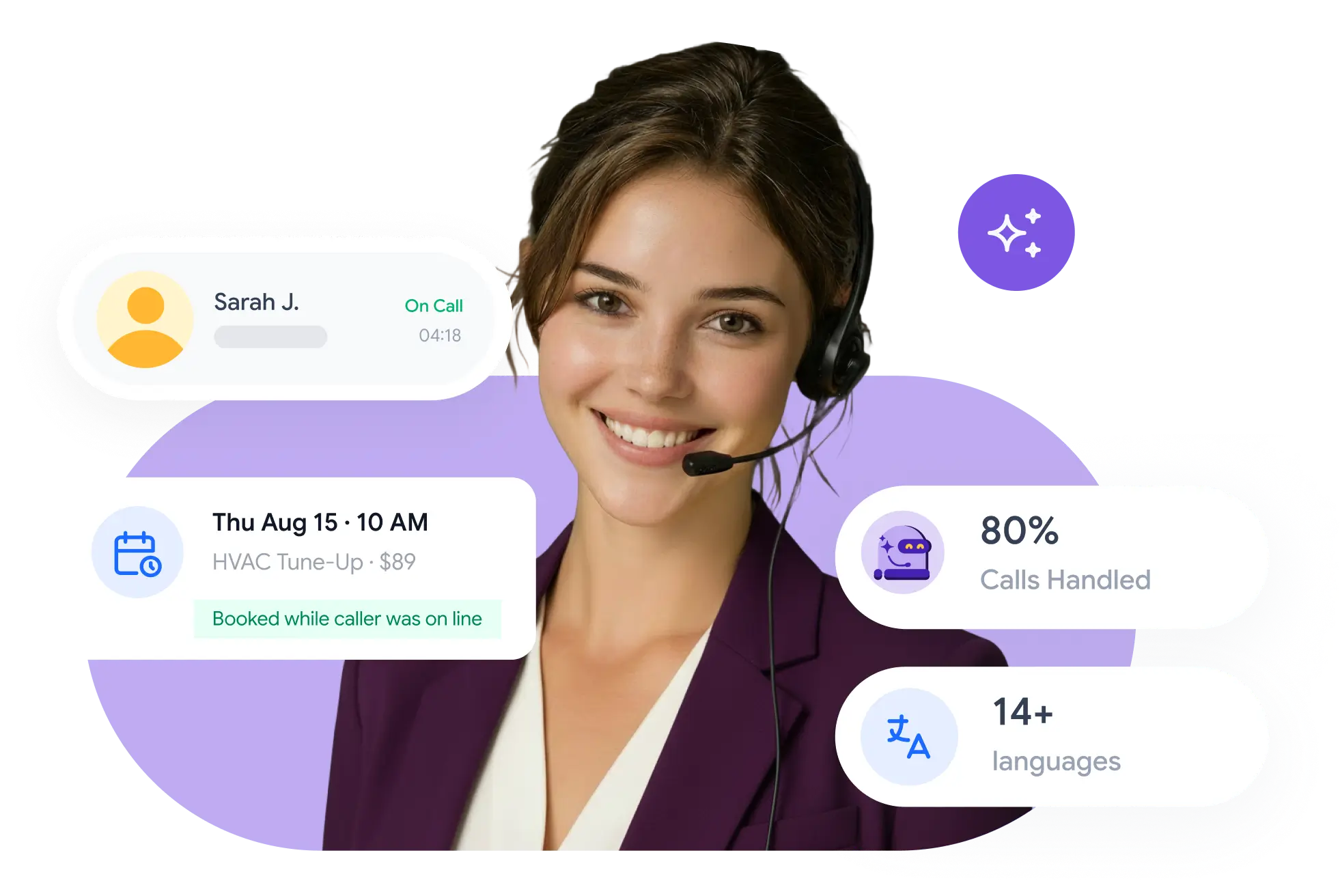
An AI receptionist is a 24/7 phone answering system powered by artificial intelligence that picks up your business calls, responds in natural conversational language, and takes real action: booking appointments, qualifying leads, routing emergencies, answering questions. No human on the other end. The key difference from voicemail: it gets callers to a resolution before they hang up.
What is an AI receptionist?
An AI receptionist is software that sits on your business phone line. When someone calls, it picks up in two to three rings with a natural-sounding voice, listens to what the caller needs, and responds the way a trained human receptionist would.
What separates it from the robotic phone trees of ten years ago is the technology underneath. Modern AI receptionists use natural language processing (the same core technology behind ChatGPT) to understand what a caller is actually saying, not just catch keywords. If someone calls and says "my AC stopped blowing cold air yesterday, I need someone to come out," the AI understands that as a service request. Not a billing question. Not a cancellation.
It then acts on it. It might book a service appointment directly into your calendar, ask qualifying questions first, give a ballpark estimate based on your actual pricing, or route the call directly to your cell if it's a genuine emergency.
That's the real difference between an AI receptionist and a voicemail box. Voicemail is passive. An AI answering service for small business is active: it moves the caller toward a resolution.
What does an AI receptionist actually do?
Here's where most people have questions. Let me walk through each capability the way I explain it to clients before we build.
1. Answers every call 24/7, including after hours
Yes. This is the main reason most service businesses need one.
Between 35% and 47% of all calls to small businesses come in outside business hours. That's real customers calling at 7 PM when your office is closed, or 8 AM on a Saturday when no one has picked up yet. A well-configured AI phone answering service handles every one of those calls the same way it handles a Tuesday afternoon call.
I've had HVAC clients book service jobs at 11:30 PM on a Friday through their AI receptionist. Without it, that would have been a voicemail the customer never left. 62% of callers won't leave a voicemail. They just call someone else.
2. Books appointments directly into your calendar
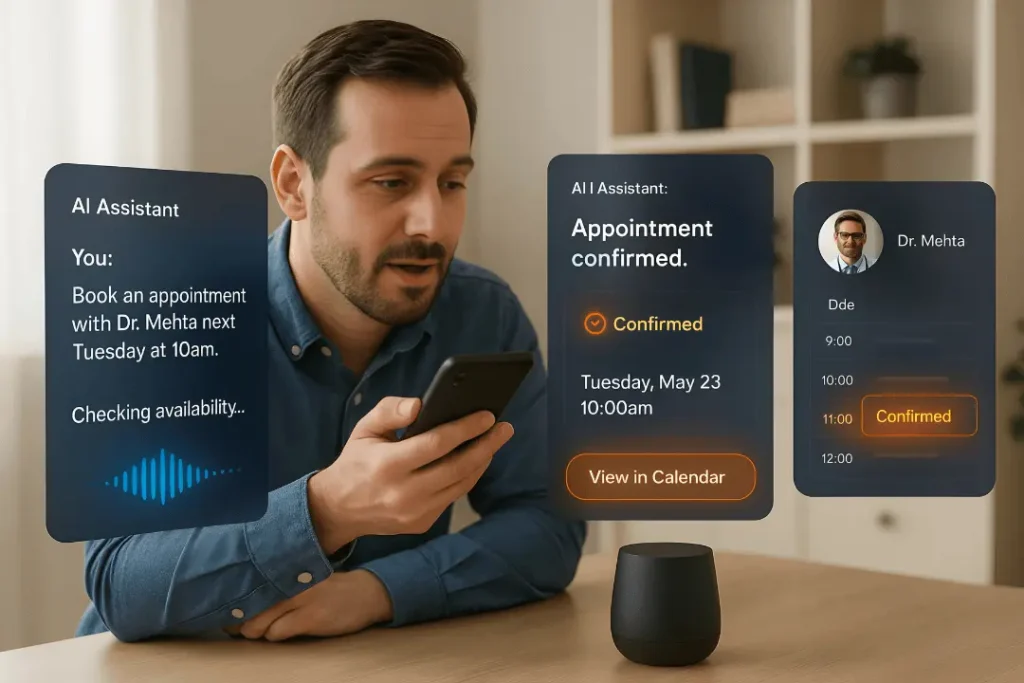
A properly built AI receptionist for service businesses connects directly to your calendar (Google Calendar, Outlook, or whatever you're already using) and books in real time during the call. The caller says they want Thursday afternoon, the AI checks availability, confirms a slot, and sends a confirmation text or email. All before the caller hangs up.
No callback needed. No phone tag. No double-bookings.
3. Qualifies leads so you stop chasing dead ends
This is one of the most underrated capabilities of an AI receptionist for small business. Before routing a call or locking in a time, a properly configured system asks the right screening questions. What's the issue? What's your zip code? Residential or commercial? Approximate square footage?
That information tells you immediately whether a caller is a real prospect. You stop spending 20 minutes on the phone with people three zip codes outside your service area.
4. Gives pricing estimates over the phone
At SimplifAI, I train each AI receptionist on the client's actual service tiers and rate ranges. So if someone calls asking "roughly what does a tune-up run?" the AI gives them a real ballpark based on your pricing, not a dodge like "we'd have to send someone out first to give you a number."
That upfront transparency keeps callers on the line and builds trust before you've ever spoken to them yourself.
5. Handles emergency call routing for trades businesses
This is one of the most important things to get right, especially for trades businesses. A pipe leaking at midnight is a completely different call than someone asking about your spring specials.
Emergency routing for HVAC, plumbing, and electrical businesses
A properly trained AI receptionist recognizes emergency language ("flooding," "no heat," "gas smell," "sparking," "pipe burst," "no power") and routes those calls directly to your on-call number in real time. Routine calls get handled automatically. True emergencies always reach a human.
6. Answers your FAQs consistently, every single time
Every service business answers the same handful of questions fifty times a week: What are your hours? Do you cover my area? What does X cost? Which brands do you carry?
The AI is trained on your business, so it answers these accurately every single time. It doesn't have an off day. It doesn't give a different answer depending on who picked up. That kind of consistency is actually difficult to maintain with human staff, especially as you grow.
7. Integrates with your CRM and scheduling software
Modern AI answering services for small business integrate with most CRMs, calendars, and workflow platforms. After every call, the system can log caller details to your CRM, update a contact record, trigger a follow-up SMS, and add the appointment to your schedule automatically, with no manual data entry.
At SimplifAI, every build connects to whatever tools a client is already using. The point is to fit your existing workflow, not make you build a new one around ours.
8. Filters out spam and robocalls
Roughly 7% of all incoming business calls are spam or robocalls. In some industries like electrical contracting, that number hits 15%. Most AI receptionist platforms include built-in spam filtering that catches these before they ever ring through, keeping your lead pipeline clean.
See it in action: AI receptionist for a car service business
The best way to understand what an AI receptionist actually sounds like is to hear one. Here's a real example of an AI receptionist handling calls for a car service business. Watch how it answers questions about services, provides pricing, and books the caller in. This is exactly the kind of system I build for clients.
Want to call one yourself? The AI Receptionist page has live demo lines for HVAC, real estate, lawn care, and auto detailing, all active 24/7.
Who is an AI receptionist for?
Not every business needs one. Here's a straight answer on who benefits most and who probably doesn't.
The right fit: your business probably needs an AI receptionist if:
- You run a home services or trades business: HVAC, plumbing, electrical, roofing, landscaping, auto detailing, pest control. These businesses take calls from people with an immediate problem. If you don't answer, someone else does.
- You run an appointment-based service: salons, dental practices, real estate, chiropractic offices, physical therapy. If your calendar is your revenue, you want it filling itself while you're working.
- You're a solo operator or small team doing the work and answering the phone at the same time. One of those things suffers. Usually it's the phone.
- After-hours calls represent real revenue: emergency repairs, urgent care, real estate inquiries. If the phone ringing at 10 PM is a genuine business opportunity, it needs to be answered.
- You've outgrown voicemail but aren't ready to hire a full-time receptionist. A human receptionist costs $45,000 to $65,000 per year with salary and benefits. An AI receptionist runs a fraction of that and works 168 hours a week.
Probably not the right fit if:
- Every call requires deep, immediate human judgment: complex legal intake, psychiatric services, high-stakes financial decisions where nuance matters from the first second.
- You receive fewer than 20 calls per month. At that volume, the math doesn't work. You can handle those calls yourself.
- Your industry has strict regulatory rules around recorded communications. Worth checking before setting anything up.
👤Traditional Answering Service
- ×Human operators using generic scripts
- ×Business hours only, limited weekend coverage
- ×Charges per minute, unpredictable costs
- ×Takes messages, promises callbacks
- ×$500–$2,000/month plus per-minute fees
🤖AI Receptionist (SimplifAI)
- ✓Custom-trained on your specific business
- ✓24/7 including evenings, weekends, holidays
- ✓Flat monthly rate, predictable
- ✓Books appointments and qualifies leads in real time
- ✓Starting at $297/month
What does an AI receptionist not do?
I'd rather be straight about this than have you find out after you've committed.
AI receptionists handle structured, repeatable tasks extremely well. They're not built for emotionally charged conversations, complex complaints that require investigative judgment, or situations where a distressed caller needs a real human voice from the very first second. Any well-designed setup includes clear rules for when the AI hands off to a person, and those handoff moments matter.
“The AI is only as good as how it's trained. A poorly configured AI receptionist that gives wrong pricing, misrepresents your services, or fails to catch an emergency is worse than no AI at all.”
— Ted Manas, Founder, SimplifAI Solutions
An off-the-shelf bot that isn't trained on your specific business will sound generic and robotic. Callers notice. This is why at SimplifAI, I build every receptionist from scratch on each client's actual services, pricing, service area, and call flow, rather than dropping a template in and calling it done.
Is your business losing money to missed calls right now?
Probably, and here's how to find out.
Take your average job value. Multiply it by the number of calls you realistically miss in a month. Then multiply by your close rate on the calls you do answer. That number is a conservative floor for what unanswered calls are costing you.

Quick missed-call calculation
Average job value × missed calls per month × your close rate = monthly revenue lost to voicemail. A plumber with a $600 average job who misses 20 calls a month at a 40% close rate is leaving close to $4,800 on the table every single month. The AI receptionist doesn't cost anywhere near $4,800.
I've run this calculation with clients across plumbing, HVAC, roofing, and real estate. The number is always bigger than they expected. For a full breakdown of what AI receptionist service actually costs versus what missed calls cost, the AI receptionist pricing guide walks through the full ROI math.
Common mistakes to avoid when setting up an AI receptionist
Buying a generic off-the-shelf bot. Most cheap AI receptionist apps aren't trained on your specific business. They give generic answers, miss industry-specific language, and sound robotic enough that callers hang up. That makes the problem worse, not better.
Setting it up and forgetting it. Your business changes. Pricing changes, service areas change, team structure changes. Your AI receptionist needs to stay current. Build in a review every 90 days at minimum.
Skipping emergency call routing. If the AI treats a gas leak the same as someone asking about your summer promotions, that's a serious failure point. Emergency routing isn't optional for any trades business.
Hiding that it's AI. Some businesses try this. I'd argue against it. Being upfront ("Hi, I'm an AI assistant for [Business Name]") builds more trust than a voice that almost sounds human but not quite. Callers are fine with AI when it genuinely helps them.
Not reviewing the call data. Every call gets logged. After the first few weeks, review the transcripts. What questions came up that the AI didn't answer well? What did people call about that you didn't train for? The data is where you find the improvements.
If you're a service business missing calls you don't even know about, an AI receptionist is worth taking seriously. The fastest way to see what one would sound like for your specific business is to book a free call. No slides, no pitch, just a conversation about whether it makes sense for you.
Want this for your business?
Book a free call and we'll show you exactly what a custom AI receptionist would sound like for your business.
Book a Free CallFrequently Asked Questions
What is an AI receptionist?
An AI receptionist is a software system that answers your business phone calls using artificial intelligence. It responds to callers in natural conversational language and takes real action: booking appointments, qualifying leads, answering FAQs, and routing urgent calls to a human. No one on your team needs to pick up the phone.
What can an AI receptionist do for a small business?
A well-built AI receptionist for small business can answer calls 24/7, book appointments directly into your calendar, qualify inbound leads with custom screening questions, provide pricing estimates, filter spam calls, route emergencies to your cell phone, and log every interaction to your CRM automatically.
Who should use an AI receptionist?
Service businesses that take regular inbound calls and cannot afford to miss them. This includes HVAC companies, plumbers, electricians, roofers, landscapers, real estate agents, auto detailers, salons, dental offices, and any solo operator or small team that is doing the work and answering the phone at the same time.
Is an AI receptionist better than a human answering service?
For most service businesses, yes. A traditional answering service charges per minute, uses operators reading generic scripts, and typically only works during business hours. An AI receptionist works 24/7 at a flat monthly rate, is trained specifically on your business, and actively books appointments rather than just taking messages.
How much does an AI receptionist cost compared to a human receptionist?
A human receptionist costs $45,000 to $65,000 per year once you include salary, benefits, and overhead. A full-featured AI phone answering service for small business typically runs $200 to $500 per month, and works 168 hours a week with no sick days, no turnover, and no overtime.
Will my callers know they are talking to an AI?
Modern AI voices are dramatically more natural than they were a few years ago. Most callers do not immediately realize they are speaking with AI. Being transparent ("Hi, I'm an AI assistant for [Business Name]") builds trust and sets the right expectations. Callers are generally fine with AI when it actually helps them.
How long does it take to set up an AI receptionist?
At SimplifAI Solutions, a custom-built AI receptionist typically goes live within a few days of the initial onboarding call. That time is spent training the AI on your specific services, pricing, service area, and call flow so it sounds like it actually knows your business, not a generic template.